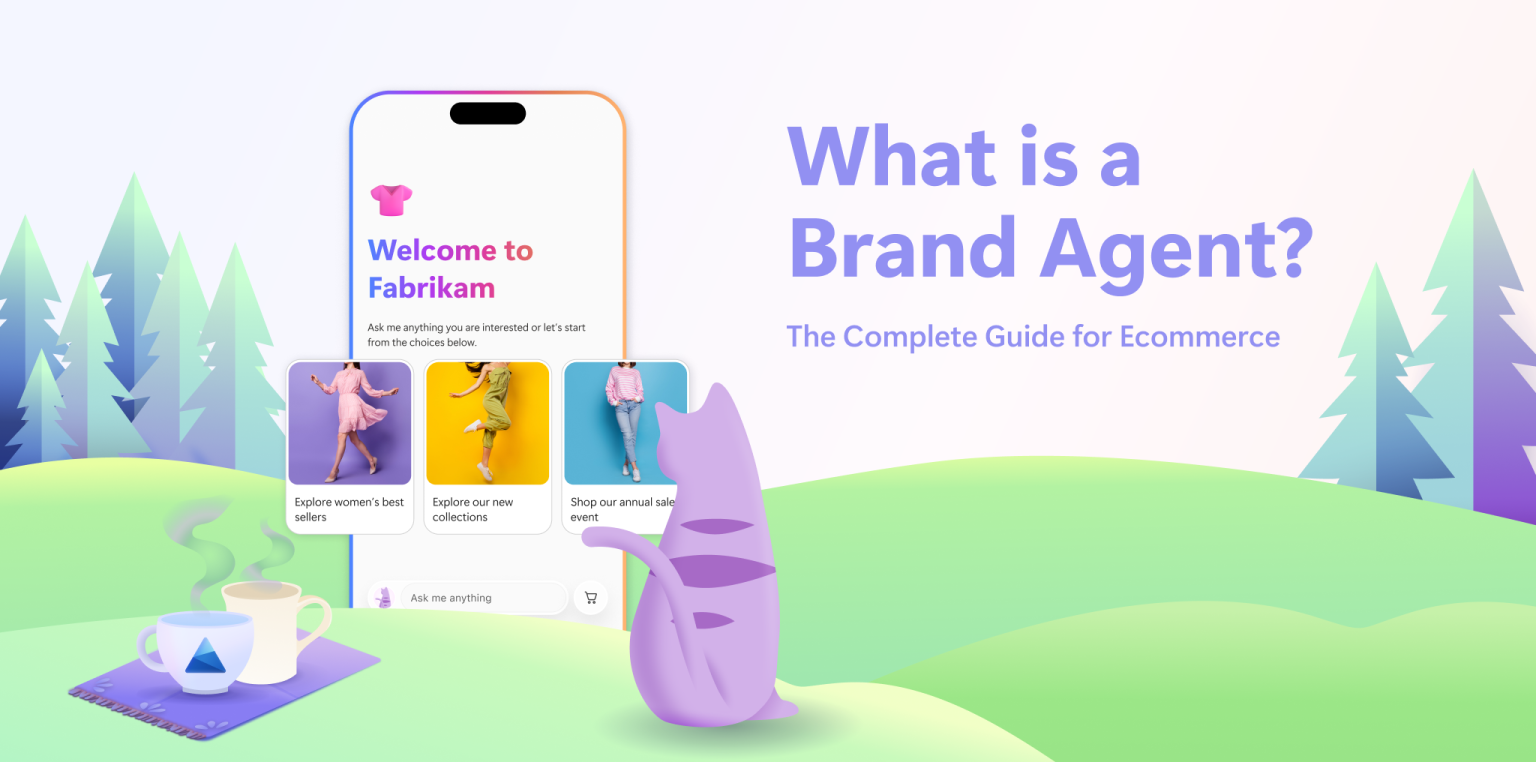
Imagine walking into an online store and being greeted by a knowledgeable sales associate who already understands what you’ve browsed, what you’ve added to cart, and what questions you’re likely to ask next.
Not a static FAQ. Not a generic chatbot. But a real-time assistant that represents the brand by learning product data, understanding shopper behavior, and actively guiding people toward purchase.
That’s the idea behind Brand Agents.
As ecommerce becomes more competitive and customer expectations rise, brands need more than static product pages and passive search bars. They need something that engages, adapts, and converts.
Brand agents are the next evolution of that experience.
Defining a Brand Agent
A Brand Agent is a conversational AI that lives on your website and represents your brand by engaging users in real time, guiding product discovery, answering questions, and assisting with transactions.
It combines:
- Live catalog awareness
- Context from shopper interactions
- Brand-specific knowledge (shipping, policies, guidance, tone)
- Real-time conversational ability
With the goal of increasing engagement and conversion.
Because this space is evolving, similar concepts are referred to as:
- AI Sales Agent
- Agentic Storefront
- AI Shopping Assistant
- Conversational Commerce Agent
- AI Commerce Assistant
Why Ecommerce Sites Are Turning to Brand Agents
The shift is happening for a simple reason: shoppers expect interaction, not static content.
Today, customers often:
- Bounce when they can’t quickly find answers
- Abandon carts due to uncertainty
- Leave when product differences aren’t clear
- Search for support outside the site
Brands attempt to solve this with chat widgets or FAQ bots, but most tool slack in-depth product awareness and behavioral context. Brand Agents change that.
They are trained on:
- Your product catalog
- Shipping & return policies
- Store-specific knowledge
- Real-time browsing behavior
Instead of asking shoppers to search manually, the agent proactively helps.
How It Benefits Brands
1. Higher Conversion Through Guided Discovery
The agent removes the friction between intent and purchase by:
- Recommending releveant products
- Suggesting bundles
- Answering comparison questions
- Adding products to cart directly inside chat
2. Context-Aware Assistance
Because it integrates with behavioral signals, an agent can:
- Recognize what a shopper is viewing
- Reference products already explored
- Respond with relevant suggestions
3. Real-Time Engagement
Brand agents operate 24/7. They step in at the right moment using behavioral cues:
- When someone lingers on a product
- When someone hesitates in checkout
- When a shopper asks repeated questions
4. Measurable Impact
Within analytics, brands gain visibility into:
- Sessions with vs. without agent assistance
- Conversion differences
- Funnel drop-offs
- Conversation depth
- Interaction heatmaps and session replays
5. Brand Alignment
The agent is configured to reflect your brand identity:
- Custom tone
- Visual styling
- Product-aligned responses
- Brand voice consistency
It becomes an extension of your storefront, not a generic AI overlay. Enrichment with your own knowledge base further strengthens this alignment.
How It Benefits Customers
While brands optimize for revenue and insight, customers benefit from something more immediate:
- Faster Answers: No more hunting through FAQs or waiting for support replies. The agent answers instantly in natural language.
- Personalized Guidance: It remembers preferences within a session and adapts recommendations accordingly. Customers feel understood rather than marketed to.
- Interactive Product Exploration: Instead of static pages, shoppers can: ask follow-up questions, compare options, view product previews, and add to cart directly.
Why Brand Agents Are Different Than Chatbots
Most ecommerce brands aren’t starting from zero. You probably already have:
- An analytics platform tracking sessions and conversions
- A customer support chat tool handling tickets
- A recommendation engine suggesting products
- A CRM storing customer history
That’s a modern commerce stack where each system serves a clear purpose. They’re powerful, but they operate independently.
Analytics observes behavior. Support responds to problems. Recommendation engines surface static suggestions. CRMs store past interactions.
They are aware of the customer, but they don’t participate in the user experience with them.
In contrast, a Brand Agent is a proactive assistant that participates in the user journey alongside the customer.
A brand agent understands what the shopper is looking at, knows what’s in their cart, recognizes hesitation patterns, and makes adjustments based on live behavior.
Real Use Cases for Brand Agents
Product Discovery
Imagine a shopper lands on your site. She’s looking for a foundation that won’t dry out her skin under makeup.
Normally, she’d:
- Open multiple product tabs
- Scroll through reviews
- Check ingredients
- Possibly leave
Instead, she asks a question.
The brand agent responds immediately with tailored recommendations pulled from your catalog. It explains why one product works better for dry skin, shows previews, and allows her to add it to cart without leaving the conversation.
Purchase Assistance
A few minutes later, the same customer hesitates and wonders, “Will this arrive before Friday?”
Instead of navigating to your shipping page, she gets a clear, instant answer based on your actual policy from the agent. The uncertainty disappears. The purchase continues.
Cart Abandonment Recovery
Now imagine a different scenario. A shopper adds two items to cart but hesitates. No checkout.
Instead of watching the session fade out, the agent gently intervenes and asks, “Can I help you compare these?” or “Would you like to see similar bundles?”
This type of high-intent intervention turns potential cart abandonments into completed purchases.
Customer Support Automation
And then there’s the quiet, constant pressure most ecommerce teams feel.
Answering the same questions, over and over again:
- “Do you ship internationally?”
- “Is this true to size?”
- “How long do refunds take?”
- “When will this be back in stock?”
The individual impact of each of these questions is small, but collectively they consume hours. Without an agent, those questions turn into tickets, and tickets turn into queues. Eventually, queues turn into delayed responses and, sometimes, lost sales.
With a brand agent, those answers happen instantly. As a result, customers don’t wait, support teams don’t drown in repetition, and humans can focus on the conversations that actually require nuance and care.
How Brand Agents Work
At a high level, brand agents operate by combining three layers: Knowledge, Context, and Interaction.
They ingest structured information about your business, such as products, policies, and documentation, and use AI to interpret that information conversationally. At the same time, they observe what a shopper is doing in real time, allowing responses to adapt to live intent rather than static rules.
Instead of prewritten scripts, brand agents generate responses dynamically, grounded in your brand’s data.
The result is an AI system that can:
- Understand questions in natural language
- Pull relevant product or policy information
- Adapt responses based on browsing behavior
- Guide shoppers toward decisions
Under the hood, brand agents follow a similar pattern:
- Integration into the storefront: The agent is embedded directly into the website experience, often through a lightweight script or platform integration.
- Catalog and policy ingestion: Product data, availability, pricing, shipping details, and return policies are processed so the agent can respond accurately.
- Behavioral context awareness: The agent interprets what a shopper is viewing, searching, or adding to cart.
- Dynamic response generation: Rather than selecting from fixed answers, the agent generates contextual responses in real time.
Example: Setting Up a Brand Agent in Shopify
That’s the high-level overview of how brand agents operate. Now, let’s dive a bit deeper and take a look at what it looks like to set up a brand agent on your website.
For this example, we’re going to use Microsoft Clarity’s new Brand Agent, which is available in beta for Shopify stores.
Adding this agent to your Shopify Store involves the following steps:
- Install the Clarity App in your Shopify store.
- A script is injected to add the chat interface to your storefront.
- Your product catalog and store policies are ingested into the system.
- Configure the agent to align with your brand tone and identity.
Depending on catalog size, ingestion can take minutes to hours as the system builds a structured understanding of the store.
How to Get Started
Brand agents are still an evolving technology, and that’s what makes this moment interesting.
The shift from static storefronts to intelligent, responsive commerce isn’t theoretical anymore. It’s happening now. And the brands that experiment early will help define what this category becomes.
If you’re curious how a brand agent could help your store, the simplest place to begin is by testing one.
Microsoft Clarity’s Brand Agent is currently free during beta and available for Shopify stores, with more platforms coming soon. You can join the waitlist, explore the setup process, and see what it looks like to add an AI-powered sales associate to your storefront.